Jivan Dhakal
English Language Teacher at Madanadev Secondary School, Humla, Nepal, and Developer-Researcher of the Song-Based Grammar Teaching Approach (SBGTA)
Introduction
Grammar has traditionally been considered one of the most challenging components of English language learning, particularly in English as a Foreign Language (EFL) contexts. In remote districts of Nepal such as Humla, learners often encounter additional barriers including limited exposure to English, inadequate learning resources, weak foundational knowledge, and anxiety toward grammar learning. Conventional grammar instruction, largely dominated by rule memorization and teacher-centered practices, frequently fails to engage learners meaningfully.
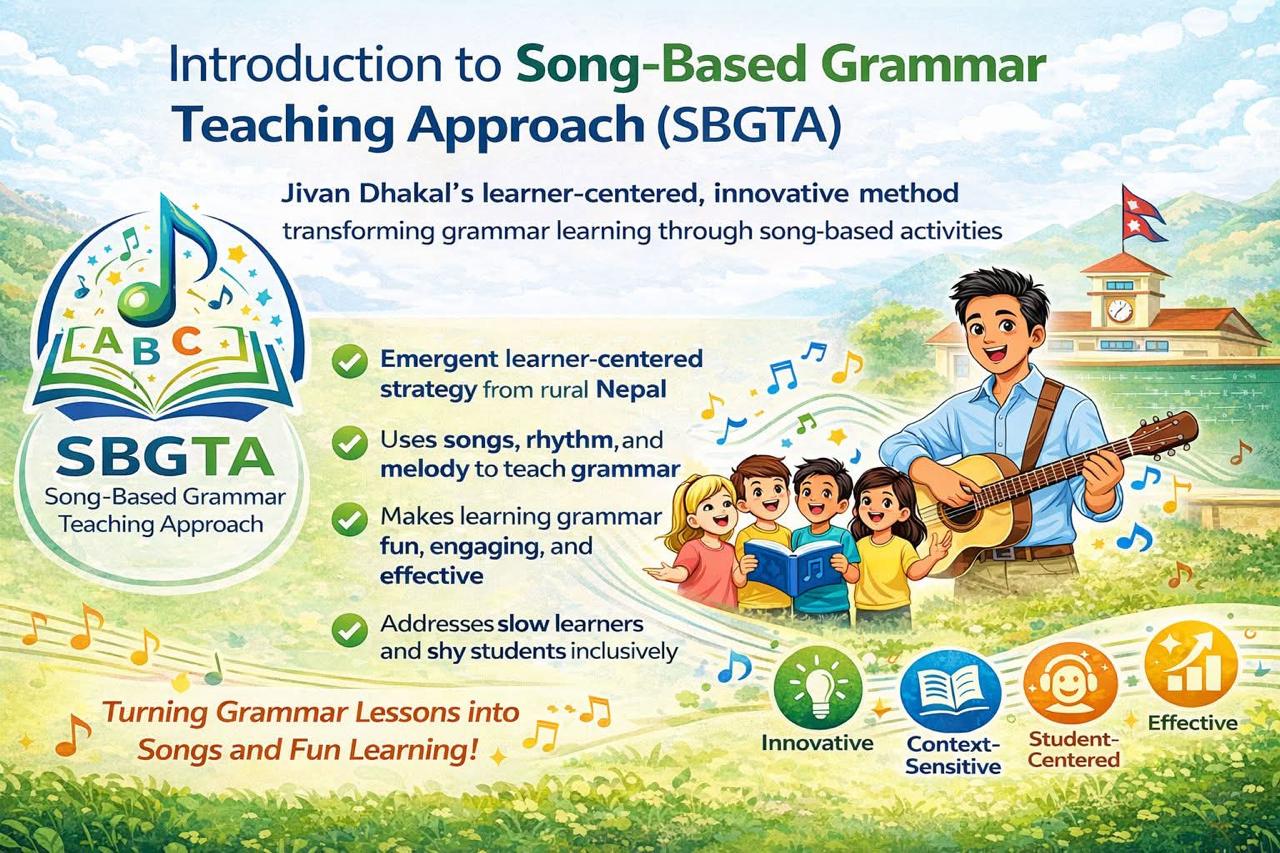
To address these challenges, Song-Based Grammar Teaching Approach (SBGTA) was developed and practiced by Jivan Dhakal over nearly six years of classroom teaching experience. Emerging from continuous observation, reflection, and experimentation in real classroom settings, SBGTA integrates songs, rhythm, melody, repetition, and local cultural music into grammar instruction. The approach transforms grammar learning from a rigid and intimidating subject into an enjoyable, memorable, and meaningful experience.
Unlike traditional methods that emphasize memorization of isolated rules, SBGTA enables learners to experience grammar actively through singing, repetition, performance, and practical application. The approach is particularly effective in low-exposure EFL contexts where opportunities to use English outside the classroom are limited.
What is SBGTA?
The Song-Based Grammar Teaching Approach is a learner-centered methodology that teaches grammar through specially composed songs. Grammar rules are embedded within lyrics and presented through familiar tunes, often adapted from local musical traditions such as Deuda, Thadi Bhaka, Deusi, and Dohori.
Through repeated singing and guided practice, learners internalize grammatical structures naturally and develop the ability to use them confidently in communication.
Key Characteristics of SBGTA
SBGTA possesses several distinctive characteristics:
– Learner-centered and participatory.
– Grammar taught through songs and musical performance.
– Context-sensitive and suitable for low-exposure EFL environments.
– Child-friendly, enjoyable, and stress-free.
– Uses rhythm, melody, and repetition to enhance retention.
– Inclusive for slow learners and academically weaker students.
– Encourages collaboration, creativity, and learner autonomy.
– Promotes practical application of grammar in communication.
– Integrates mother tongue support when necessary.
– Time-efficient and adaptable across various grammar topics.
– These features make SBGTA particularly relevant for rural and resource-constrained schools.
Classroom Implementation
SBGTA can be implemented through six instructional stages:
1. Warm-Up and Topic Introduction
Teachers activate learners’ prior knowledge and generate interest in the target grammar item.
2. Presentation of Grammar Song
The teacher introduces a grammar song using a familiar rhythm or local tune.
3. Student Singing and Repetition
Learners sing and repeat the song collectively and individually to reinforce understanding.
4. Explicit Grammar Explanation
The teacher briefly explains the grammar rule embedded within the song lyrics.
5. Guided Practice
Students engage in oral and written activities to practice the target structure.
6. Real-Life Application
Learners use the grammar structure in dialogues, role-plays, conversations, and meaningful communication tasks.
Pedagogical Principles
SBGTA is guided by several important educational principles:
– Learning through enjoyment.
– Active learner participation.
– Experiential learning.
– Contextualized grammar instruction.
– Low affective filter.
– Mother-tongue scaffolding.
– Inclusiveness and equity.
– Learner autonomy.
– Context-sensitive pedagogy.
– Practical application of knowledge.
These principles ensure that grammar learning addresses both cognitive and emotional dimensions of language acquisition.
Theoretical Foundations
Although developed through classroom practice, SBGTA aligns closely with established educational theories.
Krashen’s (1982) Input and Affective Filter Hypotheses support the use of comprehensible input in a low-anxiety environment.
Vygotsky’s (1978) Sociocultural Theory emphasizes collaborative learning, peer interaction, and scaffolding, all of which are integral to SBGTA.
Constructivist Learning Theory highlights learners’ active construction of knowledge through meaningful experiences.
Gardner’s Multiple Intelligences Theory (1983) recognizes musical intelligence as a valuable pathway to learning.
Similarly, SBGTA reflects principles of Communicative Language Teaching (CLT) and Post-Method Pedagogy, emphasizing context-sensitive and learner-centered instruction.
Major Findings from Classroom Practice
Long-term classroom implementation revealed several significant outcomes:
Improved grammatical accuracy.
Better retention and recall of grammar rules.
Increased learner confidence and motivation.
Reduced fear and anxiety toward grammar learning.
Greater classroom participation.
Enhanced communicative competence.
Positive impact on slow and weaker learners.
Improved learner autonomy.
Reduced instructional burden on teachers after song internalization.
Greater suitability for remote and low-exposure EFL contexts.
Students demonstrated stronger understanding and practical application of grammar compared to traditional rule-based instruction.
Strengths and Challenges
Strengths
Makes grammar enjoyable and memorable.
Enhances motivation and engagement.
Supports long-term retention.
Encourages inclusive learning.
Promotes communicative use of grammar.
Adapts well to rural and resource-poor settings.
Integrates local culture and music.
Challenges
Requires teacher creativity and preparation.
Some teachers may lack confidence in musical instruction.
Large classrooms can be difficult to manage.
Certain abstract grammar topics may require additional explanation.
Limited availability of ready-made grammar songs.
Alignment with examination-oriented systems may be challenging.
Despite these limitations, most challenges can be addressed through teacher training, contextual adaptation, and professional collaboration.
Contribution to EFL Pedagogy
One of the major contributions of SBGTA is its ability to bridge the gap between theory and practice. While many teaching approaches originate primarily from academic theory, SBGTA emerged from sustained classroom experience in a remote Himalayan context.
The approach demonstrates that locally developed pedagogical innovations can effectively address contextual challenges while remaining theoretically grounded. It also highlights the importance of integrating culture, creativity, and learner engagement into grammar instruction.
Conclusion
The Song-Based Grammar Teaching Approach (SBGTA) represents an innovative, context-sensitive, and learner-friendly model for grammar instruction. By combining songs, rhythm, repetition, local culture, and meaningful communication, it transforms grammar learning into an enjoyable and effective process.
Particularly in remote and low-exposure EFL contexts, SBGTA offers a practical solution to longstanding challenges in grammar teaching. The positive outcomes observed through years of classroom implementation suggest that this approach has significant potential to contribute to English language teaching not only in Nepal but also in similar educational settings worldwide.
As educational systems increasingly emphasize learner engagement, inclusiveness, and contextual relevance, SBGTA provides a promising pathway toward more meaningful and effective grammar education.
References
Gardner, H. (1983). Frames of Mind: The Theory of Multiple Intelligences. Basic Books.
Krashen, S. D. (1982). Principles and Practice in Second Language Acquisition. Pergamon Press.
Kumaravadivelu, B. (2001). Toward a Postmethod Pedagogy. TESOL Quarterly, 35(4), 537–560.
Lo, R., & Li, H. C. (1998). Songs Enhance Learner Involvement. Forum, 36(3), 8–11.
Medina, S. L. (1993). The Effect of Music on Second Language Vocabulary Acquisition. National Network for Early Language Learning, 6(3), 1–8.
Millington, N. T. (2011). Using Songs Effectively to Teach English to Young Learners. Language Education in Asia, 2(1), 134–141.
Murphey, T. (1992). Music and Song. Oxford University Press.
Paquette, K. R., & Rieg, S. A. (2008). Using Music to Support the Literacy Development of Young English Language Learners. Early Childhood Education Journal, 36(3), 227–232.
Schoepp, K. (2001). Reasons for Using Songs in the ESL/EFL Classroom. The Internet TESL Journal, 7(2).



 २०८३ मंसिर ५ - शनिबार